__manifest__.py (__openerp__.py)
Filename
- Use
__openerp__.pyfor odoo 9.0 and earler versions. - Use
__manifest__.pyfor odoo 10.0 and later versions, but don’t rename filename on porting module from one version to another
Template
Use example below as template. What are important here:
- order of attributes
- not used attributes are represented
- quote characters (
",""") - empty lines
- no description attribute
- price and currency attributes are commented-out if not used
- comma after last item in list (e.g. in ‘depends’ attribute)
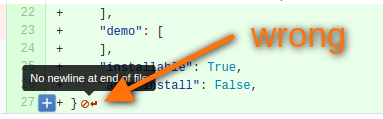
- add new line symbol at the end of file (i.e. right after last
})
# Copyright 2018 {DEVELOPER_NAME} <https://it-projects.info/team/{DEVELOPER_GITHUB_USERNAME}>
# License LGPL-3.0 or later (https://www.gnu.org/licenses/lgpl.html).
{
    "name": """{MODULE_NAME}""",
    "summary": """{SHORT_DESCRIPTION_OF_THE_MODULE}""",
    "category": "{MODULE_CATEGORY}",
    # "live_test_url": "http://apps.it-projects.info/shop/product/DEMO-URL?version={ODOO_BRANCH}",
    "images": [],
    "version": "{ODOO_BRANCH}.1.0.0",
    "application": False,

    "author": "IT-Projects LLC, {DEVELOPER_NAME}",
    "support": "apps@it-projects.info",
    "website": "https://it-projects.info/team/{DEVELOPER_GITHUB_USERNAME}",
    "license": "LGPL-3",
    # "price": 9.00,
    # "currency": "EUR",

    "depends": [
        "{DEPENDENCY1}",
        "{DEPENDENCY2}",
    ],
    "external_dependencies": {"python": [], "bin": []},
    "data": [
        "{FILE1}.xml",
        "{FILE2}.xml",
    ],
    "demo": [
        "demo/{DEMOFILE1}.xml",
    ],
    "qweb": [
        "static/src/xml/{QWEBFILE1}.xml",
    ],

    "post_load": None,
    "pre_init_hook": None,
    "post_init_hook": None,
    "uninstall_hook": None,

    "auto_install": False,
    "installable": True,

    # "demo_title": "{MODULE_NAME}",
    # "demo_addons": [
    # ],
    # "demo_addons_hidden": [
    # ],
    # "demo_url": "DEMO-URL",
    # "demo_summary": "{SHORT_DESCRIPTION_OF_THE_MODULE}",
    # "demo_images": [
    #    "images/MAIN_IMAGE",
    # ]
}
See also:
summary
Short description of the module. E.g. you can describe here which problem is solved by the module. It could sound as a slogan.
category
Categories from the list below are preferred.
AccountingDiscussDocument ManagementeCommerceHuman ResourcesIndustriesLocalizationManufacturingMarketingPoint of SaleProductivityProjectPurchasesSalesWarehouseWebsiteExtra Tools
version
Note: whenever you change version, you have to add a record in changelog.rst
The version number in the module manifest should be the Odoo major version (e.g. 8.0) followed by the module x.y.z version numbers. For example: 8.0.1.0.0 is expected for the first release of an 8.0 module.
The x.y.z version numbers follow the semantics breaking.feature.fix:
- x increments when the data model or the views had significant changes. Data migration might be needed, or depending modules might be affected.
- y increments when non-breaking new features are added. A module upgrade will probably be needed.
- z increments when bugfixes were made. Usually a server restart is needed for the fixes to be made available.
If applicable, breaking changes are expected to include instructions or scripts to perform migration on current installations.
If a module ported to different odoo versions (e.g. 8 and 9) and some update is added only to one version (e.g. 9), then version is changed as in example below:
- init
- 8.0.1.0.0
- 9.0.1.0.0
- feature added to 8.0 and ported to 9.0
- 8.0.1.1.0
- 9.0.1.1.0
- feature added to 9.0 only and not going to be ported to 8.0:
- 8.0.1.1.0
- 9.0.1.2.0
- fix made in 9.0 only and not going to be ported to 8.0:
- 8.0.1.1.0
- 9.0.1.2.1
- fix made in 8.0 and ported to 9.0
- 8.0.1.2.2
- 9.0.1.2.2
i.e. two module branches cannot have same versions with a different meaning
author
Use company first and then developer(s):
"author": "IT-Projects LLC, Developer Name",
In the main, if module already exists and you make small updatesfixes, you should not add your name to authors.
author in OCA
For OCA’s repositories put company name first, then OCA. Developers are listed in README file:
"author": "IT-Projects LLC, Odoo Community Association (OCA)",
website
Url to personal page at company’s website (e.g. "https://it-projects.info/team/yelizariev")
license
IT-Projects LLC uses following licences:
"GPL-3"for odoo 8.0 and below"LGPL-3"for odoo 9.0 and above
For OCA’s repositories use "AGPL-3".
external_dependencies
Check if some python library exists:
"external_dependencies": {"python" : ["openid"]}
Check if some sytem application exists:
"external_dependencies": {"bin" : ["libreoffice"]}
See also: External dependencies in odoo